
On this page
- 1. Check the information behind the chart
- 2. Find your starting point on the wheel
- 3. Read a small example before tackling the whole chart
- 4. Combine planet, sign, and house into one sentence
- 5. Read one aspect and check the degrees
- 6. Write a short reading, then compare it with experience
- Your first birth-chart reading worksheet
To read a birth chart, check the birth details and chart settings, locate the Ascendant, then read the Sun and Moon by sign and house. Add one clear aspect between them before writing a short interpretation. Working in that order helps you connect the pieces without trying to decode every symbol at once.
This guide walks through a deliberately simplified example, then gives you a worksheet for your own chart. It uses Western astrological symbolism as a tool for reflection. A precisely calculated position and an interpretation of that position are different kinds of information.

1. Check the information behind the chart
Have the chart wheel and its accompanying list of placements open together. The list is often easier to read than the wheel when symbols or labels overlap.
Check these details before interpreting anything:
- Birth date, recorded local time, and birthplace. Confirm AM or PM and that the chart service handles the correct time zone and daylight saving rules.
- Zodiac convention. This walkthrough uses the tropical zodiac. A sidereal chart uses a different reference, so placements can differ.
- House system. This example uses whole sign houses. Keep your chosen system consistent throughout a reading.
- Chart type. Select the natal chart for your first pass. A transit overlay adds another set of planets and can make the wheel harder to follow.
If the terminology is unfamiliar, our introduction to what a natal chart shows explains the ingredients.
If your birth time is unknown, leave the Ascendant and houses out of your personal reading. A noon placeholder does not establish either one. The Moon can also change signs during a birth date, so its sign may need to remain uncertain. Use the example below to learn the method, and see where to look for your birth time before applying the house steps to yourself.
2. Find your starting point on the wheel
Look for ASC or AC, meaning Ascendant. It marks the degree of the zodiac rising on the eastern horizon at birth and is usually shown on the left of a Western chart wheel. The sign containing that point is your Rising sign.
Next, identify three layers:
- The signs divide the zodiac into twelve 30-degree sections.
- The house numbers identify twelve areas of life.
- The planet markers show positions within those signs and houses.
The small numbers beside a planet usually give its degree and minutes within a sign. For example, 12° Virgo means twelve degrees into Virgo, not “the twelfth house”. Use the chart's legend or placement list to distinguish these numbers.
Houses run anticlockwise around the usual Western wheel. In whole sign houses, the entire rising sign is house 1, the next sign is house 2, and so on. The exact Ascendant can sit inside house 1 rather than at its boundary. The Astrology Podcast's explanation of whole sign houses describes this convention.
Other house systems can put more than one sign inside a house. Do not force a Placidus chart to match the equal sectors below. Cafe Astrology's chart-wheel tutorial illustrates how to follow unequal house boundaries.
3. Read a small example before tackling the whole chart
Invented teaching example: the following positions were chosen to demonstrate a reading. They are not calculated from a person's birth details. Only the Ascendant, Sun, Moon, and one aspect are shown.
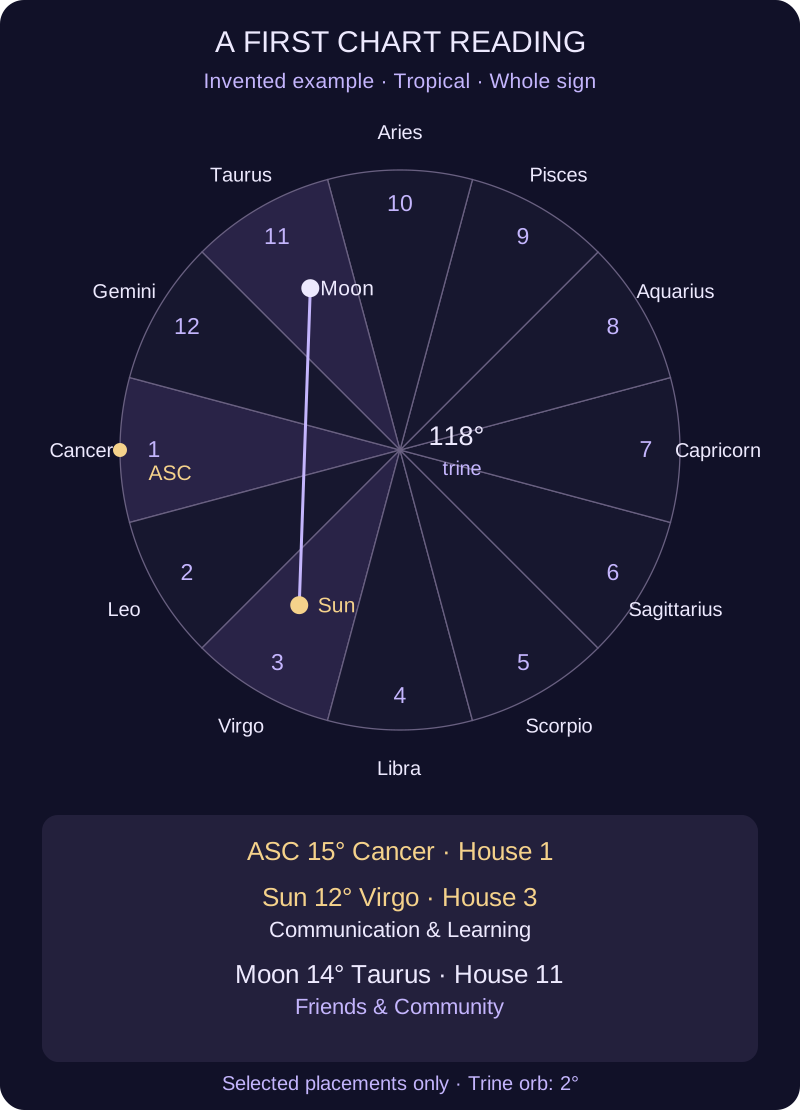
The Sun and Moon markers sit at their stated zodiac degrees. The line shows their 118° separation, a trine with a 2° orb. Unmarked houses in this partial diagram are not evidence of empty houses in a complete chart.
Here are the same details in text:
- Ascendant: 15° Cancer. Cancer occupies house 1.
- Sun: 12° Virgo, house 3 — Communication & Learning.
- Moon: 14° Taurus, house 11 — Friends & Community.
- Selected aspect: Sun trine Moon, 2° from the exact 120° angle.
Starting with Cancer as house 1 makes Leo house 2 and Virgo house 3. Continuing around the zodiac puts Taurus in house 11. Aries is house 10 here, which is why house 1 should never automatically be labelled Aries.
4. Combine planet, sign, and house into one sentence
Use this simple structure: the planet's theme, expressed in the sign's style, explored in the house's area of life.
For a first reading, common associations are the Sun with identity and self-expression, the Moon with emotional needs and familiar responses, and the Rising sign with how you approach situations. These are interpretive conventions, not measurements of personality. CHANI's overview of chart components introduces these associations.
Begin with the Sun
In our example, combine:
- Sun: identity and self-expression.
- Virgo: noticing details, refining, and making something useful.
- House 3: communication and learning, including everyday exchanges.
A possible reading is: “I could explore self-expression through explaining ideas carefully or improving a skill.”
This is more useful than stopping at “Virgo means perfectionism”. It gives the symbolism a setting. A practical question is: When does revising my message make it clearer, and when does it stop me sending it? The detail-oriented symbolism comes from Virgo's astrological tradition, described in Astrology.com's Virgo guide.
Add the Moon
Now read Moon in Taurus in house 11:
- Moon: emotional needs and familiar responses.
- Taurus: steadiness, continuity, and tangible comfort.
- House 11: friends and community.
One possible interpretation is: “Familiar friendships and dependable group routines may be worth exploring as sources of comfort.” Astrology.com's Taurus guide describes the sign's associations with stability and the senses.
Ask: Which friendships feel dependable, and do I actually enjoy the routines we share? A weekly walk with a friend is one possible expression. It is not an event the placement predicts.
Use the Rising sign as context
Cancer rising adds a symbolic emphasis on care, familiarity, and protection when approaching something new. Those themes appear in Astrology.com's Cancer guide.
You might ask: What helps me feel comfortable enough to participate in a new group? Keep this separate from the Sun and Moon sentences at first. You are comparing themes, not choosing which sign is the “real you”.
For the meanings of other house placements, use our guide to all twelve houses as a reference rather than memorising them before you begin.
5. Read one aspect and check the degrees
An aspect connects two placements. Start with one listed in your chart's aspect grid, then check the planets and the angle rather than guessing from the colour of a line. Colours vary between chart services.
The five major angles are conjunction 0°, sextile 60°, square 90°, trine 120°, and opposition 180°. An orb is the distance from the exact aspect angle. Astrologers and software packages use different orb allowances.
In our example, Taurus begins at 30° of the zodiac and Virgo at 150°. This gives:
- Moon at 14° Taurus: 30° + 14° = 44°.
- Sun at 12° Virgo: 150° + 12° = 162°.
- Separation: 162° − 44° = 118°.
That makes this a trine with a 2° orb, because 118° is two degrees short of 120°. For any pair of placements, use the smaller angle around the circle. If subtraction gives more than 180°, subtract that result from 360°.
Astrologers often interpret a trine as a relatively easy connection. Here, one possible synthesis is that careful communication and dependable friendships could support each other. You could explore whether sharing a useful idea with a familiar group feels easier than presenting it to strangers.
Our guide to the five major aspects explains the other relationships. An aspect describes a symbolic connection, not a guarantee that life will feel easy or difficult.
6. Write a short reading, then compare it with experience
Bring the example together in three sentences:
I might express myself through careful explanations and practical learning. Familiar friends and steady group routines may offer a comfortable setting for that expression. I can explore whether feeling welcome makes it easier to share what I know.
This is an original interpretation of the teaching example, not a report about a real person. Notice that it connects the third and eleventh houses through an everyday situation. It leaves room for several possible expressions and for the reading not to fit.
A small experiment could be to share one useful resource with a group you already know. Afterwards, record what happened: Was it enjoyable? Did you over-edit it? Did the group setting help, or would a one-to-one exchange have suited you better?
The observation matters more than making your experience match the chart.
Your first birth-chart reading worksheet
Copy these prompts into a notebook and fill in the chart details before writing interpretations:
- Settings: What birth information, zodiac convention, and house system am I using? What is uncertain?
- Ascendant: What sign and degree are listed, if my birth time is known?
- Sun: What sign, degree, and house are listed? What is one possible theme + style + life-area sentence?
- Moon: What sign, degree, and house are listed? What might complement or differ from the Sun sentence?
- One aspect: Which two placements connect, what is their angular separation, and what orb is shown?
- Synthesis: What ordinary situation could connect these themes?
- Reality check: What fits, what does not, and what would I like to observe without assuming the answer?
Once those steps feel familiar, add Mercury for communication, Venus for relating and values, or Mars for action. Read each with the same sign-and-house method before adding more aspects. You can leave chart rulers, minor aspects, asteroids, and timing techniques for a later reading.
For personalised guidance using your birth details and current planetary context, create a CosmicOracle account and complete your profile. Bring one specific situation to explore, and keep any uncertain birth information explicit.