
September 28, 2026 · The CosmicOracle Team
The 12 Houses in Astrology: Meanings and How to Read Them
Learn the meanings of all 12 houses in astrology, how to find yours, what empty houses mean, and why birth time and house systems change a chart reading.
The 12 houses in astrology are divisions of a birth chart associated with different areas of life, such as home, relationships, work, and creativity. A planet's house tells an astrologer where to interpret its themes. Its sign describes how those themes might be expressed.
If you are looking for astrology house meanings, start with the life area, then add the sign and any planets placed there. These are symbolic astrological interpretations. Calculating a chart from astronomical positions does not establish that it can predict your personality or future.

Houses, signs, and planets: three different jobs
A chart becomes easier to read when you separate its layers:
- Planet: the theme being interpreted, such as Mercury's association with thought and communication.
- Sign: the style through which that theme is expressed.
- House: the area of life in which you explore it.
The first house is not automatically Aries, and the seventh is not automatically Libra. House numbers and zodiac signs describe different things. The signs occupying your houses depend on your chart. Co-Star's introduction to houses illustrates this distinction between the sign divisions and house boundaries.
If the whole chart is new to you, our guide to what a natal chart is introduces the Sun, Moon, Rising sign, and other chart ingredients.
How to find your houses in a birth chart
Use a chart calculated from your birth date, recorded birth time, and birthplace, and note the selected house system. Look for the numbered sectors or a list of planetary house placements. Every chart has all twelve houses. You do not have just one “astrology house”.
Your Ascendant, or Rising sign, helps establish the house layout. It is calculated for the eastern horizon at your birth. The chosen house system determines how the boundaries are drawn.
If your birth time is unknown, treat the Ascendant and houses as unknown too. A noon or sunrise chart can be a calculation placeholder, but it does not recover your actual birth time. An approximate time can also leave placements near a boundary uncertain. Our birth-time guide explains where to look for a more reliable record.
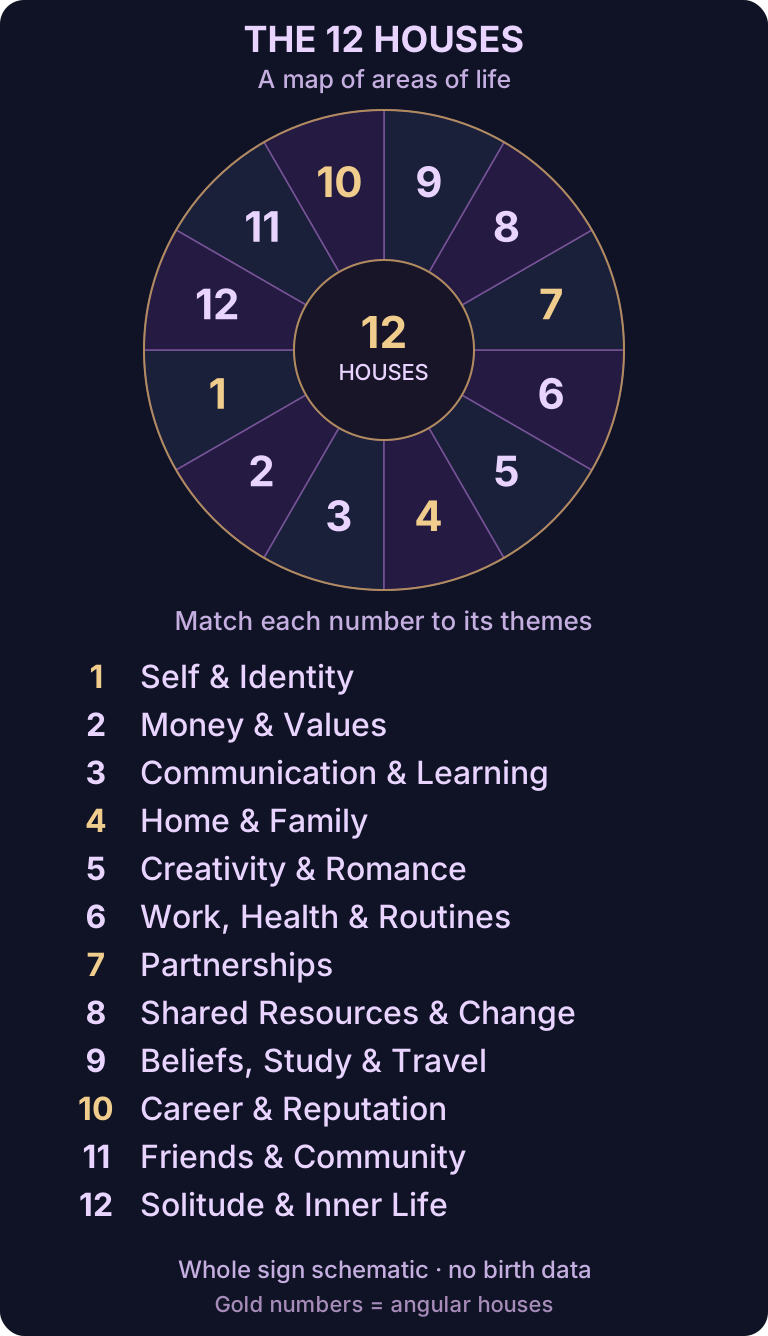
Whole sign schematic: house numbers run anticlockwise from the lower left. The numbered key uses the same theme labels as Moon Energy. Signs, the exact Ascendant, and planets are omitted. This is a teaching aid, not a calculated birth chart.
The 12 houses in astrology and their meanings
The following descriptions cover common Western astrological themes. They draw on Co-Star's house overview and CHANI's explanation of the twelve houses. Traditions differ in emphasis. The examples and reflection questions below are practical ways to explore the symbolism.
These short labels summarise a few themes for each house. They are not exhaustive definitions. For example, “Communication & Learning” also includes the third house's connections with siblings, neighbours, and short journeys.
1st house: Self & Identity
The first house concerns identity, appearance, and how you present yourself. You might explore it through the difference between how you introduce yourself at work and how you act with familiar friends.
Reflect: What do I want my first impression to communicate?
2nd house: Money & Values
The second house concerns your money, possessions, and material security. A useful everyday example is deciding which belongings you value enough to keep, repair, or replace.
Reflect: Which resources help me feel supported, and why?
3rd house: Communication & Learning
The third house concerns messages, siblings, neighbours, and your familiar surroundings. Think of a conversation with a sibling, a local class, or the information you exchange during an ordinary day.
Reflect: Where would clearer communication make daily life easier?
4th house: Home & Family
The fourth house concerns home, family background, and private foundations. Sorting inherited photographs or making a room feel more like your own gives you a concrete way to explore these themes.
Reflect: What makes a place feel like home to me?
5th house: Creativity & Romance
The fifth house concerns self-expression, enjoyment, romance, and children. It offers a lens for considering what you choose for pleasure: sketching, dancing, flirting, playing, or making something without a deadline.
Reflect: What do I enjoy when there is nothing to prove?
6th house: Work, Health & Routines
The sixth house concerns routines, everyday duties, service, and health-related themes. A practical focus might be how you organise tasks and make room for ordinary care. A placement here is not a medical diagnosis.
Reflect: Which daily habit makes my responsibilities more manageable?
7th house: Partnerships
The seventh house concerns one-to-one partnerships, including marriage and business relationships. You might explore it through how you share decisions, negotiate expectations, and honour commitments.
Reflect: What does a fair partnership look like in practice?
8th house: Shared Resources & Change
The eighth house concerns resources connected to other people, such as joint finances, debts, and inheritances. Traditional interpretations also include death and loss. Modern readings often explore intimacy and transformation. The Astrology Podcast's house discussion examines these overlapping meanings.
A shared household budget is one ordinary example. None of these associations predicts a death or a financial outcome.
Reflect: Which shared responsibilities need a clearer conversation?
9th house: Beliefs, Study & Travel
The ninth house concerns higher education, philosophy, religion, and journeys beyond familiar surroundings. Compare a quick local lesson with studying a subject that changes how you understand the world.
Reflect: Which belief am I willing to examine more closely?
10th house: Career & Reputation
The tenth house concerns vocation, public responsibilities, and reputation. You could explore it through what you want your work or community contribution to stand for, whether or not it comes with a job title.
Reflect: What would I like to be known for contributing?
11th house: Friends & Community
The eleventh house concerns friendships, networks, communities, and future aspirations. Joining a reading group or helping with a shared project gives these themes an everyday setting.
Reflect: Which communities make room for the person I am becoming?
12th house: Solitude & Inner Life
The twelfth house concerns seclusion, hidden matters, and activity behind the scenes. Modern interpretations also explore the unconscious and spiritual retreat. Quiet creative work that you keep private is one way to consider this symbolism.
Reflect: What needs some private attention before I share it?
A worked example: reading a planet, sign, and house together
Invented teaching example: imagine a whole sign chart with Aries rising and Mercury in Virgo. Counting signs from Aries makes Virgo the sixth house in this example.
Read the placement in three passes:
- Mercury: consider thinking, learning, and communication.
- Virgo: consider a style associated with detail, discernment, and refinement.
- Sixth house: bring those themes into everyday work, duties, and routines.
Mercury's communication symbolism and Virgo's attention to practical detail are described in Astrology.com's Mercury guide and Virgo guide.
One possible reflection is: “Do detailed plans help me handle everyday tasks, and when does revising the plan become a way of putting the task off?” You could try a simple checklist for a week and observe whether it helps.
That is a question to investigate, rather than a conclusion that the placement makes someone organised, anxious, or suited to a particular career. The rest of the chart adds context, including the aspects between planets. Real experience may also contradict an interpretation, and it is useful to notice when it does.
What does an empty house mean?
An empty house usually means none of the planets included in that chart is placed there. It does not mean the corresponding area of life is absent. An empty seventh house does not rule out partnership, and an empty tenth house does not rule out a meaningful career. CHANI's empty-house explanation addresses this common worry.
Astrologers often look next at the sign on the house cusp, or boundary, and the planet that rules that sign. In whole sign houses, they use the sign occupying the entire house. The ruler's placement provides another interpretive connection.
For a beginner, leave that extra layer until you are comfortable identifying the houses. You can use the reflection questions above whether a house contains several planets or none.
Why Placidus, whole sign, and equal houses differ
A house system is a method for dividing the chart. Three approaches you may encounter are:
- Whole sign: the entire sign containing the Ascendant becomes the first house. The next sign becomes the second, and so on. Each house spans one complete 30-degree sign.
- Equal house: the first house begins at the exact Ascendant degree, with subsequent boundaries spaced 30 degrees apart. This differs from beginning at the start of the rising sign.
- Placidus: a time-based method that divides rising and setting arcs. Its houses can have unequal widths along the zodiac.
The Astrology Podcast's discussion of house division explains whole sign and equal houses. Astrodienst's Swiss Ephemeris documentation describes the calculation methods.
Changing only the house system can change a planet's house assignment while leaving its zodiac sign unchanged. If two charts disagree, first check that the birth details, time-zone handling, zodiac convention, and house system match.
When learning, choose one clearly stated system and use it consistently. You can compare approaches later without treating every different placement as a different version of yourself.
What are the 1st, 4th, 7th, and 10th houses called?
They are the angular houses. In quadrant systems such as Placidus, their starting points are the Ascendant, Imum Coeli (IC), Descendant, and Midheaven (MC), respectively.
Whole sign and equal houses handle those points differently: the exact MC need not mark the tenth-house boundary. The Astrology Podcast's explanation of house-division calculations covers this distinction. Avoid assuming that every diagram's top boundary is the exact MC.
Try one house in your own chart
Choose one area you want to understand, locate its house, and write down the sign and any planets shown there. Then use its reflection question to describe one real situation in your life. Keep the chart details and your observation separate so you can see what fits and what does not.
For personalised guidance using your birth details and current planetary context, you can create a CosmicOracle account and complete your profile. Accurate birth information supports the chart calculations. When your birth time is uncertain, keep house-based interpretations uncertain too.
Keep Reading
Related Guides
January 8, 2026
What Is a Natal Chart? A Beginner's Guide to Your Birth Chart, Sun, Moon, and Rising Signs
Learn what a natal chart, or birth chart, really is, what your Sun, Moon, and Rising signs mean, and why birth time matters for accurate astrology readings.
April 16, 2026
Why Your Birth Time Matters More Than You Think in Astrology
Why does birth time matter in astrology? Learn how it affects your Rising sign, house placements, timing accuracy, and why getting it right can change how personalised readings work.
February 5, 2026
The 5 Major Astrological Aspects Explained: Conjunction, Sextile, Square, Trine, and Opposition
Learn the 5 major astrological aspects, what conjunctions, sextiles, squares, trines, and oppositions mean, and how aspects shape your birth chart and daily transits.